
What Is ASIC Mining? A Practical Guide for Australian Bitcoin Miners
Bitcoin mining has evolved fast, and so has the hardware powering it. If you’re researching “what is ASIC mining?”, chances are you’re trying to understand whether modern Bitcoin mining is still viable, and what equipment actually gives you a fighting chance in today’s competitive network.
This guide is written specifically for Australians looking to mine Bitcoin efficiently. We’ll break down what ASIC mining is, how it works, and answer the two most common questions we hear at Crypto Miners Australia: is ASIC mining better than GPU, and are ASIC miners better than GPU for real-world profitability.
By the end of this article, you’ll know whether ASIC mining aligns with your goals, your electricity costs, and your appetite for scale, and what your next step should be if you’re ready to mine seriously.
What Is ASIC Mining and Why Does It Matter for Bitcoin?
At its core, ASIC mining comes down to specialisation.
ASIC stands for Application-Specific Integrated Circuit. An ASIC miner is a machine designed to perform one task only: calculating cryptographic hashes for proof-of-work blockchains like Bitcoin. Unlike CPUs or GPUs, ASICs are not general-purpose computers — every component is engineered purely for mining efficiency.
Bitcoin uses a proof-of-work consensus mechanism, where miners compete to solve SHA-256 hashing puzzles. As Bitcoin’s network difficulty has increased, general hardware simply can’t compete anymore. That’s why mining hardware evolved from CPUs, to GPUs, and eventually to ASICs.
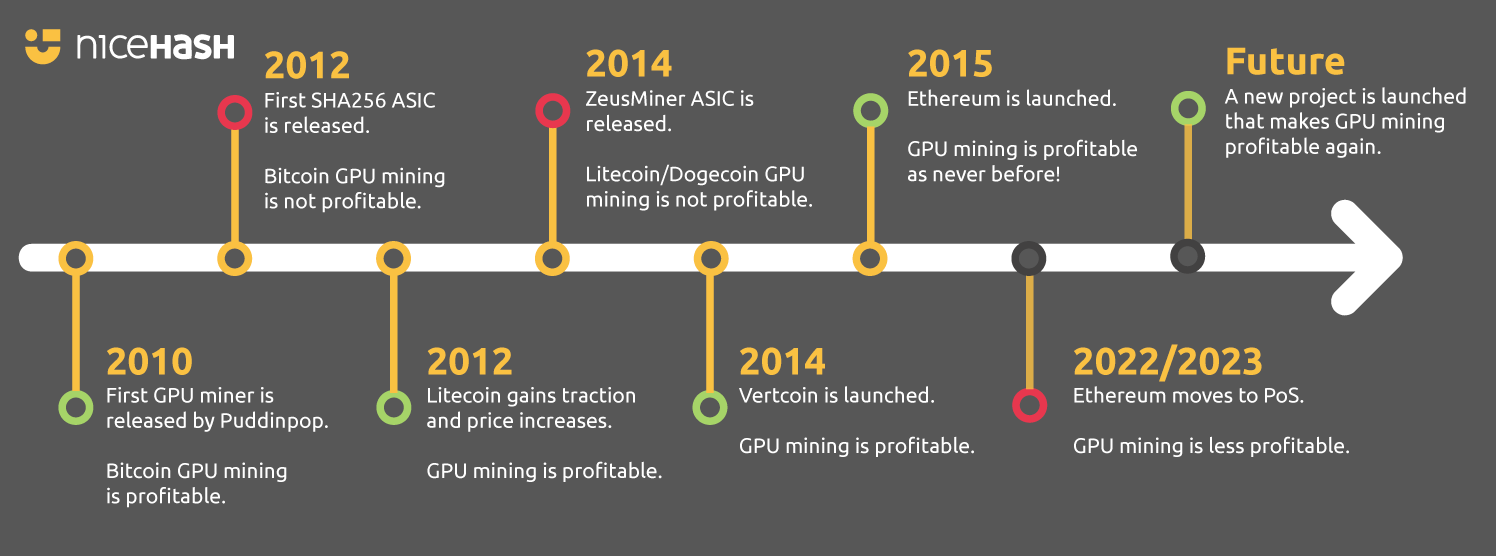
Mining hardware evolution: CPU → GPU → ASIC → Home ASICs (Bitaxe, low-power miners).
Image provided by nicehash.com
This evolution is why ASIC mining is now the standard for Bitcoin — even for home users.
How Home ASIC Miners Like Bitaxe Actually Work
ASIC miners work by continuously hashing Bitcoin block data until a valid solution is found. The speed of this process is measured in hashrate.
Even though Bitaxe miners are small, they are still true ASIC miners running dedicated ASIC chips designed specifically for Bitcoin’s SHA-256 algorithm.
Core Components of Home ASIC Miners
ASIC chip: Often derived from the same chip families used in larger miners
Low-power PSU or USB-C input: Suitable for household outlets
Quiet cooling: Small fans or passive cooling for home use
Controller & firmware: Open-source firmware for transparency and control
At Cryptominers.au, Bitaxe miners are popular because they’re:
Quiet enough for a home or office
Energy efficient
Open-source and community-driven
Ideal for learning Bitcoin mining hands-on
Home ASIC miners won’t compete with industrial farms — but that’s not the point. They’re about education, decentralisation, and participation.
ASIC vs GPU Mining for Home Bitcoin Miners
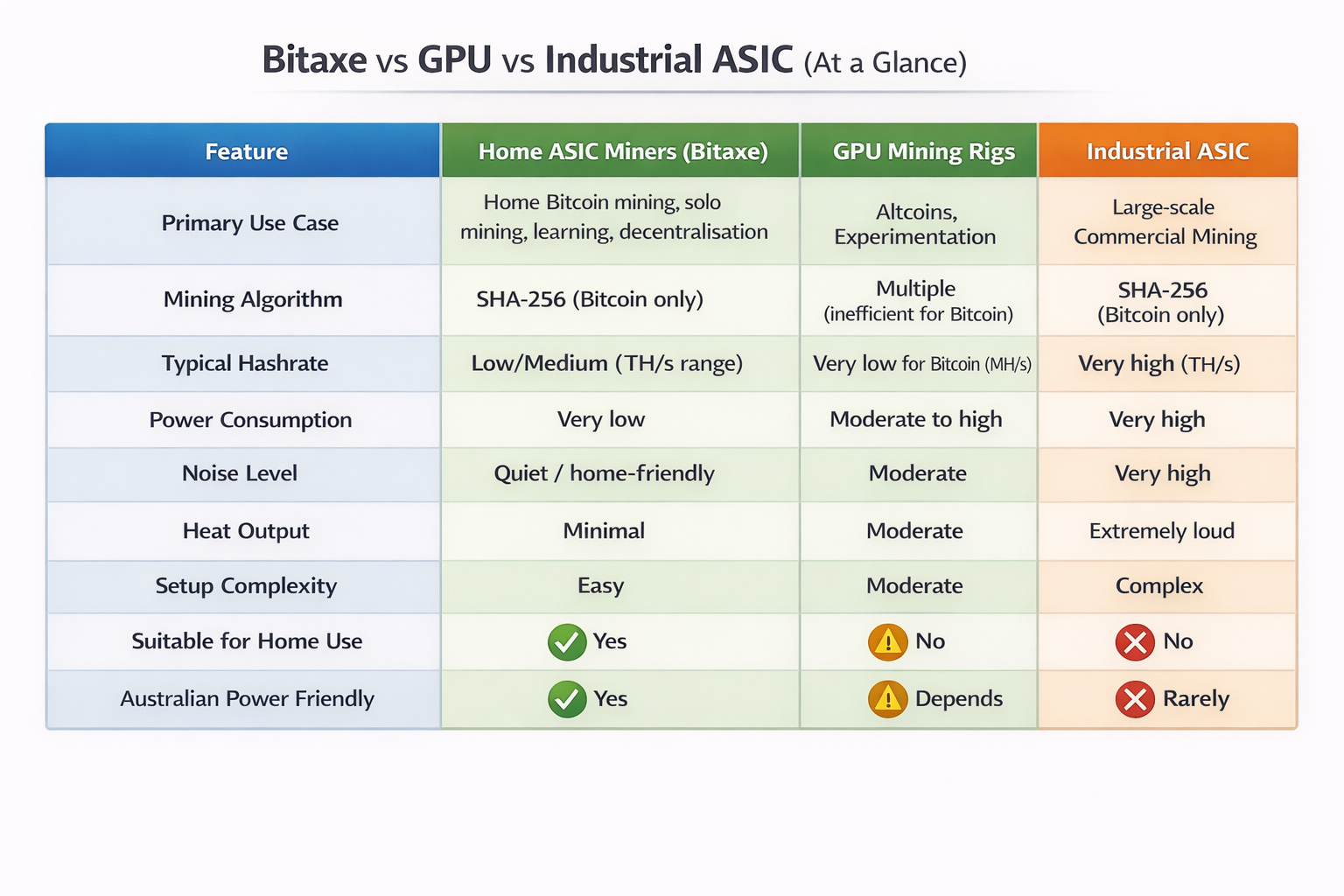
This is where most beginners ask: is ASIC mining better than GPU mining, and are ASIC miners better than GPU miners when mining at home?
1. Performance (Hashrate & Efficiency)
Even small ASIC miners outperform GPUs for Bitcoin specifically. GPUs are no longer efficient at SHA-256 mining, while ASICs - including Bitaxe devices, are designed solely for that task.
ASICs deliver far better hashes per watt, which matters when mining on residential power.
2. Energy Consumption & Power Costs
Bitaxe and similar home ASIC miners consume dramatically less power than industrial units, often comparable to a light bulb or small appliance.
For Australians concerned about electricity prices, this low draw makes home ASIC mining accessible without risking high power bills.
3. Flexibility & Learning Use Cases
GPUs are flexible and can mine different coins. ASICs are focused.
For Bitcoin learners, this focus is a strength. Home ASIC miners remove distractions and let users engage directly with Bitcoin mining mechanics.
This is why many newcomers find ASIC mining better than GPU mining when the goal is learning Bitcoin, not chasing altcoins.
4. Cost & Entry Barrier
GPUs are expensive and often overkill. Home ASIC miners like Bitaxe are affordable entry points, making ASIC miners better than GPU miners for beginners who want simplicity.
Is ASIC Mining Better Than GPU for Home Bitcoin Mining?
For Bitcoin, yes. ASIC mining is better than GPU mining, even at home.
GPUs are no longer competitive on Bitcoin’s network. ASICs, even low-power ones, are purpose-built for SHA-256 and allow users to mine Bitcoin properly, not symbolically.
GPU mining may still make sense for:
Altcoin experimentation
General computing tasks
Users not focused on Bitcoin
But for Australians interested specifically in Bitcoin, home ASIC miners are the most relevant choice today.
Running Home ASIC Miners in Australia
Home ASIC mining is legal in Australia and well-suited to residential environments when done responsibly.
Low-power ASICs like Bitaxe miners:
Run on standard household outlets
Produce minimal heat
Generate manageable noise levels
Australian electricity costs still matter, but the low wattage of home miners keeps operating costs predictable.
Many Australian users also pair home ASIC mining with solar setups, making Bitcoin mining an educational and sustainable hobby rather than a profit-maximisation exercise.
Buying locally from Cryptominers.au ensures:
Faster shipping
Local support
Products chosen specifically for Australian conditions
What to Expect From Home ASIC Mining
Home ASIC mining isn’t about replacing industrial farms — it’s about participation.
Bitaxe miners typically generate small but consistent hash power, contributing to mining pools or solo-mining experiments. Profitability depends heavily on electricity cost and Bitcoin price, but most home miners value:
Learning
Supporting decentralisation
Hands-on Bitcoin experience
Profitability calculators can still be used to estimate returns, but expectations should be realistic and long-term focused.
Getting Started With a Home ASIC Miner
Starting with ASIC mining at home is straightforward.
Simple Home ASIC Checklist:
Choose a Bitaxe or similar low-power ASIC miner
Plug into standard household power
Connect to Wi-Fi or Ethernet
Join a Bitcoin mining pool (Or host your own node)
Monitor performance via web dashboard
Cryptominers.au provides beginner-friendly ASIC miners designed specifically for this use case.
Home ASIC Mining FAQs
Is ASIC mining worth it at home in Australia?
Yes, for learning, decentralisation, and low-power participation.
How much electricity does a Bitaxe miner use?
Typically very low — often under a few hundred watts.
Can ASIC miners mine coins other than Bitcoin?
Most are Bitcoin-only due to SHA-256 specialisation.
Are home ASIC miners noisy?
Much quieter than industrial miners and suitable for home use.
Is GPU mining better for beginners?
Not for Bitcoin — ASICs are simpler and more focused.
Can I resell a Bitaxe miner later?
Yes, especially within the Bitcoin hobbyist community.
Do I need special cooling?
No — basic airflow is usually sufficient.
Can I run multiple home ASIC miners?
Yes, as long as household power limits are respected.
Final Verdict: ASIC Mining for the Home Bitcoin Miner
Understanding what is ASIC mining today means understanding how accessible it has become.
With compact devices like Bitaxe miners, Australians can mine Bitcoin from home without industrial noise, power draw, or complexity. When comparing options, are ASIC miners better than GPU miners for Bitcoin? Absolutely — especially for focused, educational, and low-power setups.
👉 Browse Bitaxe and home ASIC miners at Cryptominers.au
👉 Start mining Bitcoin from home today
👉 Join the next generation of decentralised open source miners