
Solo Bitcoin Mining in 2026: Why It Still Makes Sense for Australian Homes
Solo Bitcoin mining in 2026 isn’t about trying to compete with massive industrial farms or chasing guaranteed payouts. For Australians, it’s increasingly about energy choice.
Across the country, rooftop solar is common, midday generation is abundant, and solar feed-in tariffs continue to fall. Many households now find themselves exporting power for just a few cents per kilowatt-hour, while paying far more to buy electricity back later.
That shift changes the question entirely.
Instead of asking whether solo mining is “profitable”, more Australians are asking whether using surplus solar at home is simply a better option than exporting it cheaply to the grid. When you frame it that way, solo mining starts to look less extreme — and more practical.
What solo mining actually means today
Solo mining means your miner works independently, rather than contributing to a large pool that pays frequent but tiny rewards. If your miner finds a block, you receive the full block reward. If it doesn’t, you receive nothing.
That sounds harsh, and it can be — but it’s also the point.
In 2026, solo mining is best understood as a long-odds probability game that rewards patience, learning, and energy awareness. It’s not designed to replace pooled mining or deliver predictable income. Instead, it offers sovereignty, simplicity, and a direct connection to the Bitcoin network.
This is especially true when you’re running small, efficient, open-source miners rather than warehouse-scale closed source ASICs.
A quick reality check on mining difficulty
Mining difficulty in early 2026 has eased back from late-2025 highs. That doesn’t make solo mining easy, and it doesn’t change the underlying odds in a dramatic way — but it does matter at the margins.
When difficulty drops, each unit of hashpower has slightly better odds than before. For a home miner, that doesn’t suddenly turn mining into a sure thing, but it does make periods of lower difficulty a bit more attractive for directing surplus energy.
The key point is this: solo mining still isn’t about “beating the network”. It’s about deciding how to use energy that would otherwise be undervalued.
Why Australia is uniquely suited to solar-first mining
Australia’s energy market is what makes this discussion relevant.
In many areas, solar feed-in tariffs have fallen into the single-digit cents range. At the same time, grid electricity prices remain comparatively high. The result is that exporting solar often delivers very little value, while self-consumption delivers much more.
For households with excess midday generation, that creates a choice. You can export your solar for cents, or you can use it at home for something productive. Running a Bitcoin miner is one of the few loads that is flexible, schedulable, and perfectly suited to this kind of surplus.
That’s where small, efficient miners fit in.
The type of miners that actually make sense at home
The miners sold at Crypto Miners Australia aren’t industrial ASICs designed for warehouses. They’re compact, efficient, open-source devices built for learning, experimentation, and home use.
Bitaxe-class miners: small, quiet, solar-friendly
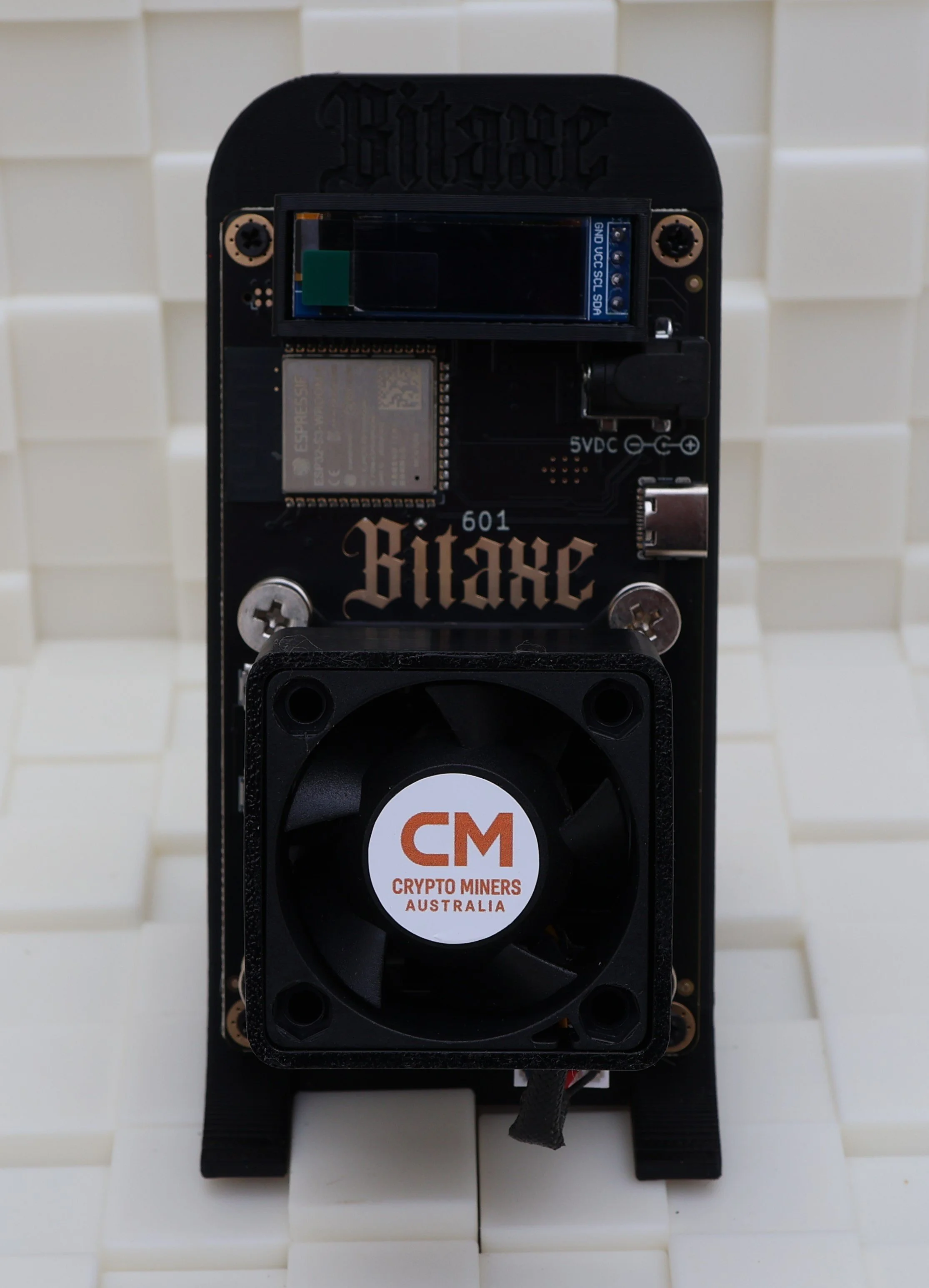
Key Specifications:
ASIC Chip: BM1370 (same as S21 Pro).
Hash Rate: Up to 1.2 TH/s (with potential for more with enhanced cooling).
Power Consumption: Around 17W-24W depending on settings.
Connectivity: Built-in 2.4G Wi-Fi (ESP32-S3).
Display: 0.96-inch OLED screen.
Cooling: 40mm dual ball-bearing fan.
Firmware: Open-source AxeOS.
Algorithm: SHA-256 (BTC, BCH, BSV, etc.).
Power Input: ATX connector, uses standard PSU.
Design: Compact, portable, desktop-friendly.
Miners like the Bitaxe Gamma 601 are designed to run on very low power. That makes them easy to pair with rooftop solar, even on modest systems.
Because they draw so little energy, they can often be run entirely during daylight hours without pulling from the grid. For many households, that means the miner is effectively consuming power that would otherwise be exported for minimal value.
These devices are ideal for people who want to understand how solo mining works in practice, learn how Bitcoin nodes and mining software interact, and contribute hashpower without noise, heat, or complexity.
NerdQaxe-class miners: more hashpower, still home-appropriate
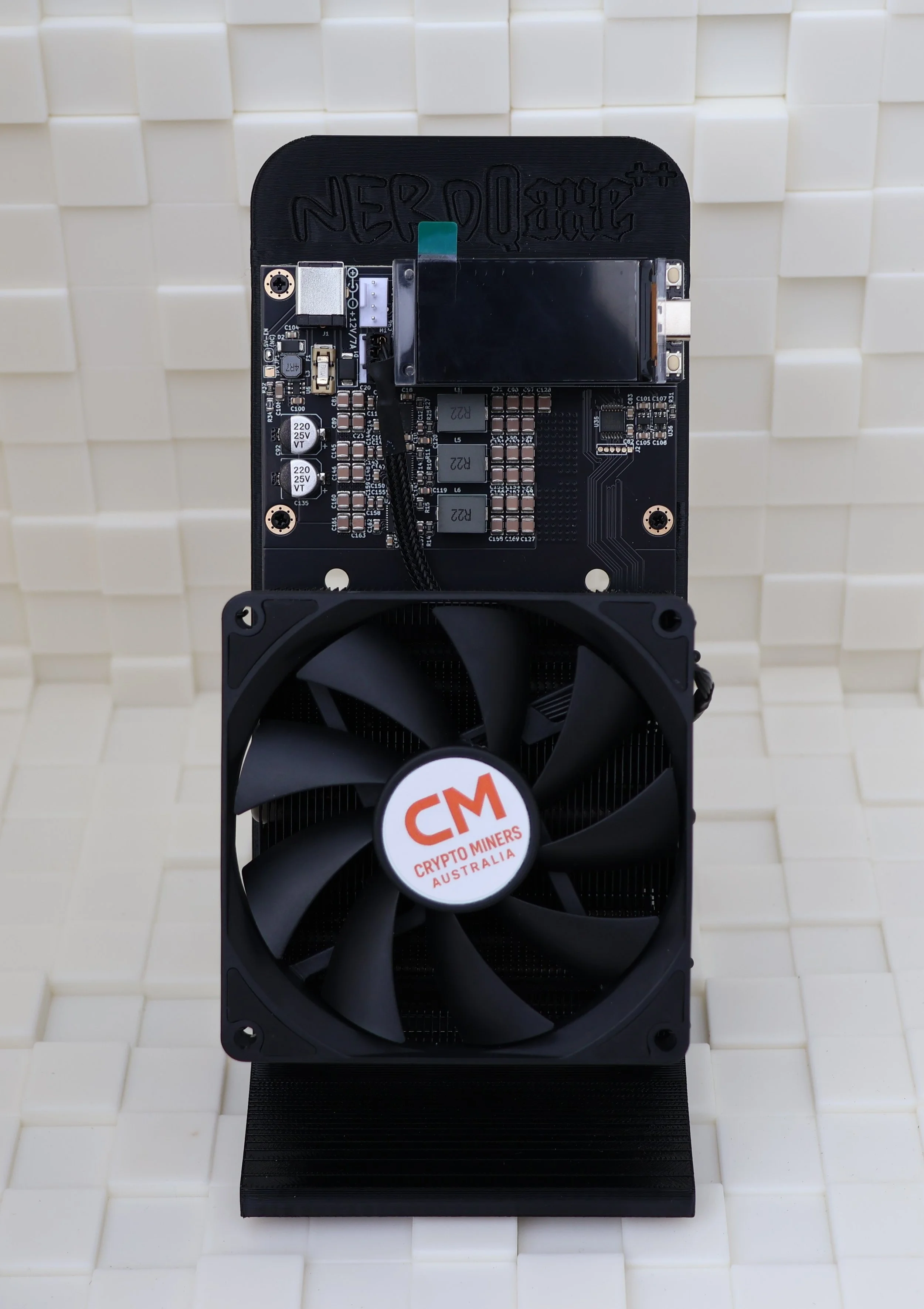
Key Specifications:
Hashrate: ~4.8 TH/s (Terahashes per second)
Power Consumption: ~60W - 80W (depending on model/settings)
Efficiency: ~15 J/TH (Joules per Terahash)
ASIC Chips: 4x BM1370 (from Antminer S21 series)
Connectivity: WLAN (WiFi) & LAN
Control: Open-Source AxeOS with LCD display
Cooling: Air cooling, designed to be quiet for home environments
Algorithm: SHA-256 (Bitcoin)
Form Factor: Compact, suitable for home/desktop use
Stepping up to something like the NerdQaxe++ gives you more hashrate while still remaining firmly in the “home-friendly” category. Power draw is higher than a Bitaxe, but still manageable for households with larger solar systems or batteries.
This kind of miner suits people who already understand the basics and want a more meaningful solo mining experience, without jumping straight to loud, power-hungry industrial hardware.
Crucially, these miners still align with a solar-first approach. They’re not designed to run flat-out on grid power 24/7 — they’re designed to be matched to your energy availability.
Solar-only vs battery-backed setups
How you power your miner matters more than which pool you choose.
A solar-only setup is the simplest place to start. The miner runs when solar generation exceeds household demand and shuts off when it doesn’t. This keeps things straightforward and avoids adding unnecessary cost or complexity. For low-power miners, this approach works extremely well.
Adding a battery changes the equation by giving you more control. Instead of exporting excess solar, you can store it and choose when to run your miner later in the day. This can improve uptime and smooth out cloud cover, but it also adds cost and efficiency losses.
Neither approach is “better” in isolation. The right choice depends on how much solar you generate, how much you export, and how much control you want over your energy use.
Solo mining as part of a broader energy mindset
One of the biggest shifts happening in Australia is the move toward daytime load shifting. Retail plans and grid incentives are increasingly encouraging households to use energy when solar is abundant, rather than exporting it.
Bitcoin miners fit neatly into that future. They’re flexible, automated, and indifferent to time of day. You can schedule them, throttle them, or turn them off entirely without affecting daily life.
Seen through that lens, solo mining becomes less about Bitcoin price and more about energy literacy and autonomy.
Is solo mining “worth it” in 2026?
Solo mining is not a shortcut and it’s not guaranteed. Anyone suggesting otherwise is overselling it.
But for Australians with rooftop solar, low feed-in tariffs, and an interest in learning how Bitcoin actually works, solo mining can be a sensible and satisfying use of surplus energy. It keeps power behind the meter, supports decentralisation, and turns undervalued solar into something tangible.
When paired with the kind of small, efficient, open-source miners sold at Crypto Miners Australia, it becomes accessible rather than extreme.
Final thoughts
Solo Bitcoin mining in 2026 isn’t about chasing certainty. It’s about making intentional choices with the energy you already produce.
If you have solar, export power during the day, and want to participate directly in the Bitcoin network, running a small home miner can make sense — not as a promise, but as a practical experiment in energy use and decentralisation.